

Filippo, let’s try to talk about terroir by imagining it metaphorically as a bouquet whose beauty emerges only when the beauty of each individual flower comes together. If we were to take one flower at a time - for example the earth, or more precisely the soil of Poggio Mandorlo - how would you describe it?
First of all, it should be noted that the soils of Poggio Mandorlo can be associated not with a single flower, but with two large “families” of flowers, very different from one another, within which we can appreciate nuances that highlight the beauty of each family and enrich the bouquet. At Poggio Mandorlo, in fact, we have soils linked to alberese formations, characterised by sometimes high levels of active limestone, rich in micro-elements, stony, with a clay - loam texture - soils on which Cabernet Franc and Merlot can express great personality. The second major “family” that further enriches the soils of Poggio Mandorlo consists of argilloscisti - grey-brown clay - schists composed of weathered marls, featuring their typical flaky structure, together with clay-limestone flysch.
Filippo, taking the second flower, let’s talk about climate or microclimate, which has a major impact on wine quality. What are your thoughts?
Climate has a huge influence on the vine’s expression. Pinot Noir, for example, in warm climates loses the silkiness, lightness, and elegance that define it in cooler continental environments with significant diurnal swings, becoming more “chewy.” Poggio Mandorlo is located on the easternmost edge of the Maremma. The presence of Mount Amiata ensures a continental climate, with more pronounced temperature swings compared to the coastal Maremma. Rainfall in this area is also significantly higher thanks to the “blocking” effect exerted by Mount Amiata - the highest mountain in the Maremma - on humid western currents. The sea’s influence is felt primarily during the hottest periods of the year, when thermal breezes keep the vine in full vegetative activity. The mountain also shields the area from the scirocco, which reaches the vineyards only softened and cooled, effectively preventing the severe dehydration events that have occurred in recent years following late-summer scirocco winds. Relative humidity here is low because Poggio Mandorlo benefits from constant breezes at 400 metres above sea level, above the “basin” effect of the valley below. To confirm the particularly favourable microclimate, one only needs to observe the lush and highly diverse woodland surrounding the vineyards - a setting reminiscent of more northern latitudes, with a freshness that later translates into the wine. This unique climate allows for a long, slow, uninterrupted ripening process that favours long-chain polyphenols, perfectly ripe and crunchy tannins, and an extremely rich aromatic profile.
Filippo, let’s move on to the mothers of the grapes - the vineyards of Poggio Mandorlo, another essential flower in our imaginary bouquet. Can we speak of character or uniqueness in each individual vineyard?
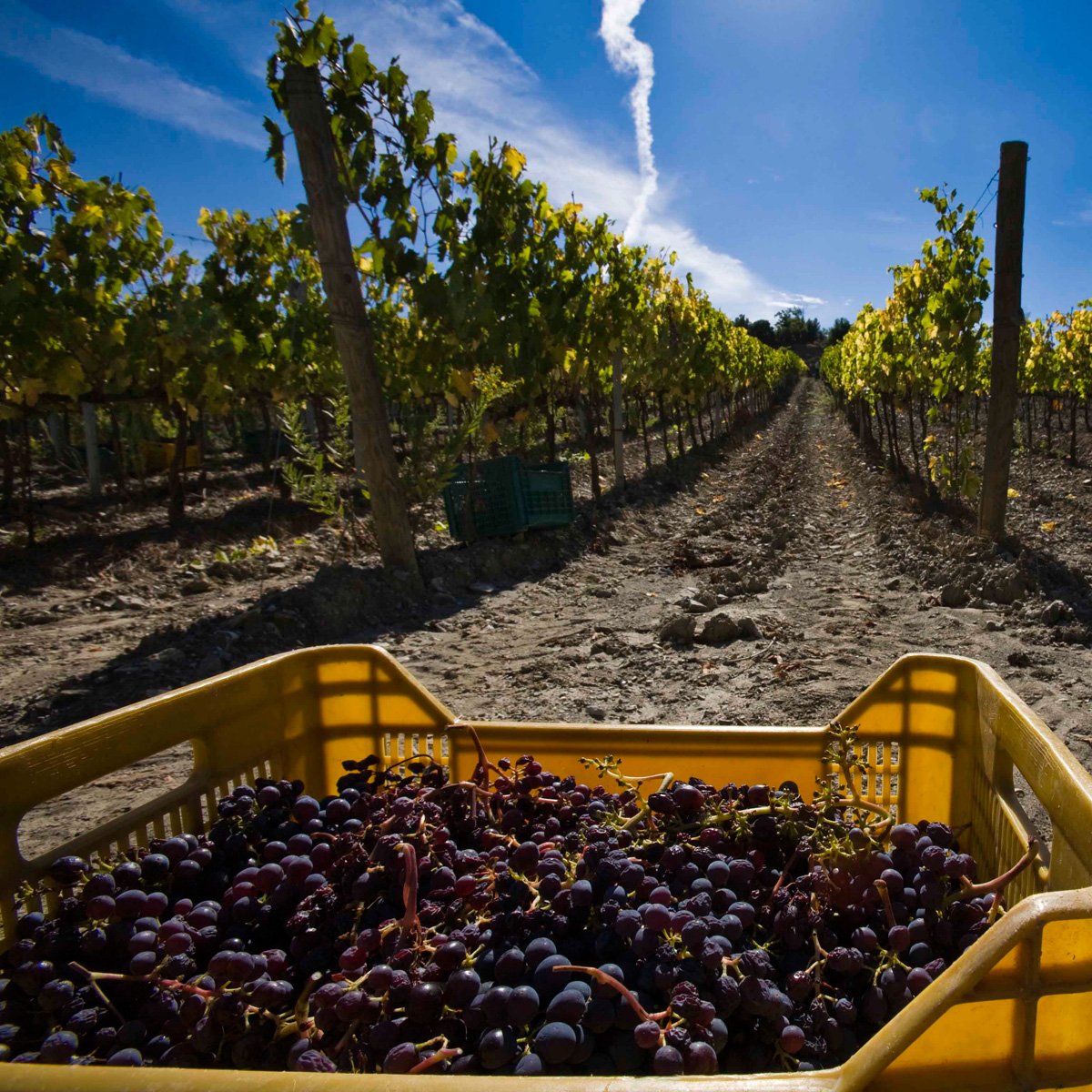
Deciding what to plant on a given plot becomes more fascinating the more freedom you have: you always start with soil and climate studies, and intuition and experience do the rest. At Poggio Mandorlo we enjoyed great freedom of choice: the discovery of calcareous soils led us straight to Cabernet Franc; the large diurnal shifts combined with the unusual freshness of the place pointed us toward Merlot; and the clay-limestone flysch indicated that Sangiovese would be its best interpreter. Each vineyard certainly has a strong and distinct character. For example, consider the two Merlot vineyards and the two Sangiovese vineyards. Merlot “Vigna Il Guardiano”, although slightly higher in elevation, has a more westerly exposure and stands on poorer, more calcareous soils: it ripens earlier and gives warmth and intensity. Merlot “Vigna Il Fosso”, though slightly lower, sits on deeper soils, with a more northern exposure, completely surrounded by woods: under these conditions Merlot extends its ripening significantly and offers menthol, eucalyptus, and silkier sensations. The two vineyards complement each other perfectly. The Sangiovese vineyards are also very different: the more “gruff” Sangiovese of Vigna Ansedonina, on clay-limestone flysch rich in stones, poor and shallow soils, contrasts with the more “thoughtful” and “calm” Sangiovese of Vigna Il Fontone, on alberese soils.
Filippo, to contextualise the saying “wine is made in the vineyard” in the reality of Poggio Mandorlo: what cultivation practices have you chosen to obtain high-quality wine?
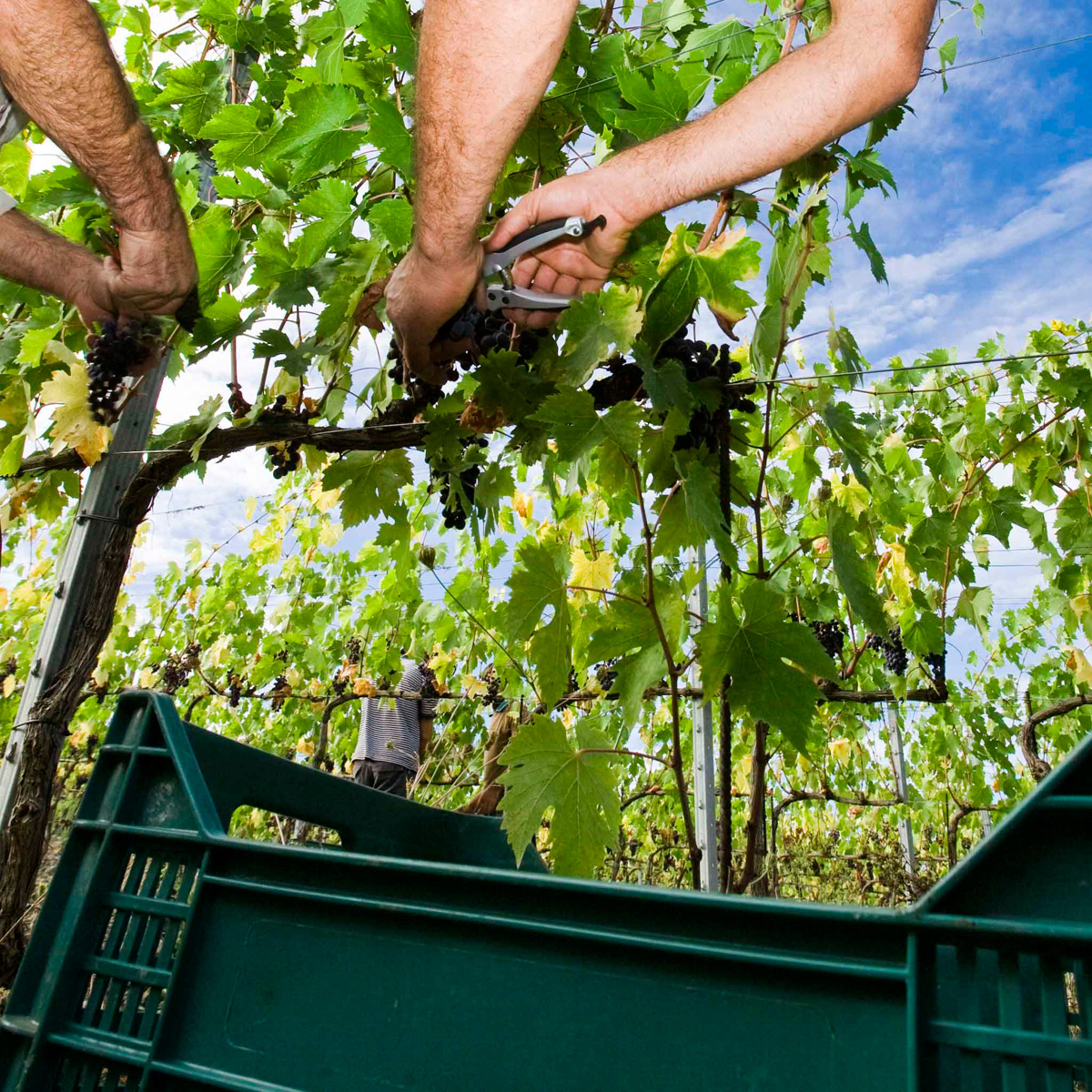
I’ll try to keep it brief, although this topic deserves far more depth. All vineyard operations aim to maintain and improve soil structure. Soil structure corresponds to its level of aggregation: particles cluster around a key colloid vital for soil life-organic matter. Incorrect practices “burn” organic matter and break these aggregates. At Poggio Mandorlo we have eliminated all operations and tools that damage soil structure. To promote soil aggregation, we incorporate organic matter through inter-row cover crops specifically designed for this purpose. We never use quick-release chemical fertilisers - only organic fertilisers - and we are designing an on-site humus production platform. High quality comes from vines in perfect balance, and this is what we aim for. Perfect balance requires a well-structured soil, rich in minerals, able to retain useful water while draining excess, permeable to oxygen, and fully accessible to deep root systems. To meet ambitious goals, canopy integrity and efficiency throughout each phase of the vine’s biological cycle are crucial. Canopy management is one of the fundamental steps in our work. The yield per vine is always reduced—through targeted interventions - to around or below one kilogram, in order to achieve perfect ripeness and a skin-to-juice ratio strongly skewed toward the skins, from which we must extract the very best during vinification. A decisive factor for quality is the choice of the harvest moment, favouring perfectly ripe, crunchy seeds and thick, consistent skins.
What does “respect for the environment,” a must in modern viticulture, really mean? And what is done at Poggio Mandorlo to pursue sustainable viticulture?
The concept of sustainable viticulture is a delicate one: by cultivating vines we force nature for human purposes, and nature reacts by putting obstacles in our way. A plant growing in a forest is in balance with its surroundings; if you turn that same plant into a hedge, pathogens will begin to hinder its development. Plant 10 hectares of the same species, and the balance is dramatically disrupted-diseases specialise, spread, and make control essential to safeguard production. Our goal is to produce healthy, perfectly ripe grapes. To control the natural forces trying to restore balance, one may choose a more or less invasive approach. Our philosophy has led us to choose the least invasive approach possible. A few examples: plant protection is entirely prevention-based, using sulphur and copper products exactly as in organic and biodynamic farming. When the season is particularly challenging, we avoid all residual products or anything that could harm beneficial insects. Pruning residues are shredded and incorporated into the soil to limit nutrient removal and return organic matter. All fertilisers are organic and supplemented with targeted cover crops. All soil work is centred on maintaining and improving soil structure and preventing erosion. The level of organic matter in our soils is very high, helping retain nutrients in the rhizosphere and reducing losses through leaching. To summarise, Poggio Mandorlo is sustainable from a chemical standpoint (reduced pesticide use), biological standpoint (preservation of soil biocenosis and beneficial insects), and physical-structural standpoint (preservation of soil structure).